
Automate your Vacuum Drying Process and Determine Completion with SNAP & Fyra
How to Determine When Your Process has Completed Drying
There are several methods used to determine when primary drying has been completed, each offering a different level of confidence and automation depending on the application.
Achieving Ultimate Vacuum is the simplest indicator of drying completion. By comparing the system’s ultimate vacuum before and after material is introduced, users can determine whether the process has returned to its baseline vacuum level, suggesting that most moisture has been removed.
An established industry method is the Rate of Rise Test, which evaluates whether a vacuum vessel has reached an acceptable level of dryness. After evacuating the vessel and isolating it from the vacuum pump, the system measures how long it takes for the pressure to increase by 1 Torr. The recorded time is then compared to predefined acceptance criteria to classify the system as either dry or wet, providing a repeatable and objective assessment of system readiness.
For applications operating below 1 Torr, DigiVac recommends the End of Drying Bundle. This solution determines the true end of primary drying by comparing a Pirani vacuum gauge, which is sensitive to water vapor, with a capacitance manometer, which measures true pressure independent of gas composition. As moisture is removed, the difference between the two readings decreases, allowing the system to automatically identify when drying is complete and adapt to batch-to-batch moisture variations without relying on fixed cycle times.
For the highest level of moisture verification, a Residual Gas Analyzer (RGA) directly measures the concentration of water vapor in a vacuum system in parts per million (PPM). Rather than inferring dryness from pressure behavior, the RGA analyzes the gas composition itself, providing quantitative confirmation of residual moisture and verifying when the desired level of dryness has been achieved.
Automated End Of Drying Bundle
One of the biggest challenges in vacuum drying is knowing exactly when primary drying has finished. Ending the cycle too early leaves residual moisture, while running too long wastes valuable production time and energy. With DigiVac’s FYRA Process Monitor paired with the SNAP Process Controller, operators can automatically identify the end of primary drying and seamlessly control the entire vacuum drying process.
The Challenge of Determining End of Drying
- Product appearance can be misleading.
- Manual monitoring requires constant attention.
- Every batch behaves differently.
- Over-drying costs time and energy.
- Under-drying risks product quality.
How FYRA Detects End of Primary Drying
FYRA End of Drying monitors the vacuum profile throughout the drying cycle.
As moisture leaves the product, the chamber pressure follows a predictable trend. Near the end of primary drying, the rate of pressure change stabilizes, allowing FYRA to identify when moisture removal has effectively completed.
Instead of relying on operator judgment, FYRA continuously analyzes the process and determines the end-of-drying point automatically using its combination of sensors.
Benefits include:
- Improved consistency
- Reduced operator intervention
- Repeatable drying cycles
- Greater confidence in product quality
For more information on how our end of drying bundle works see our end of drying blog here! The blog will cover how to take an accurate baseline and apply it in process to help time the product is in range and completed drying.
Optional: EoD Production Light Tower Alert System 
DigiVac has been developing several FYRA monitoring systems with visual and audible alarms via a light tower. This addition to the EoD set up enables a visual alarm (green) that will illuminate once the product is within a specified setpoint range of the baseline collected in the beginning. The system will also illuminate (red) when the drying has not been achieved so you are able to determine without intervention that the products are still being processed and moisture % is still too high.
This will help technicians to alert them when drying is complete and leaves out the guesswork of determining when the differentials are within the proper range of determining the end of primary drying.
Read more about our other Fyra alert systems in our blog: Simplifying Vacuum Monitoring with Smart, Visual Alarms Using the DigiVac Fyra and video on features and function here!
Automating the Entire Vacuum Drying Process with the SNAP
SNAP is DigiVac’s programmable vacuum process controller designed to automate vacuum ovens and vacuum drying systems.
SNAP is the automation platform that manages the critical functions of a vacuum drying system. Connected to a vacuum oven, it controls pumps, valves, vacuum setpoints, and—when equipped with an ATASPI module—oven temperature, allowing the entire drying recipe to run automatically. Instead of relying on operators to manually adjust process conditions or advance the cycle, SNAP executes each step of the recipe with precision. The result is a repeatable, hands-off drying process that improves consistency, reduces operator intervention, and ensures every batch follows the intended process from start to finish.
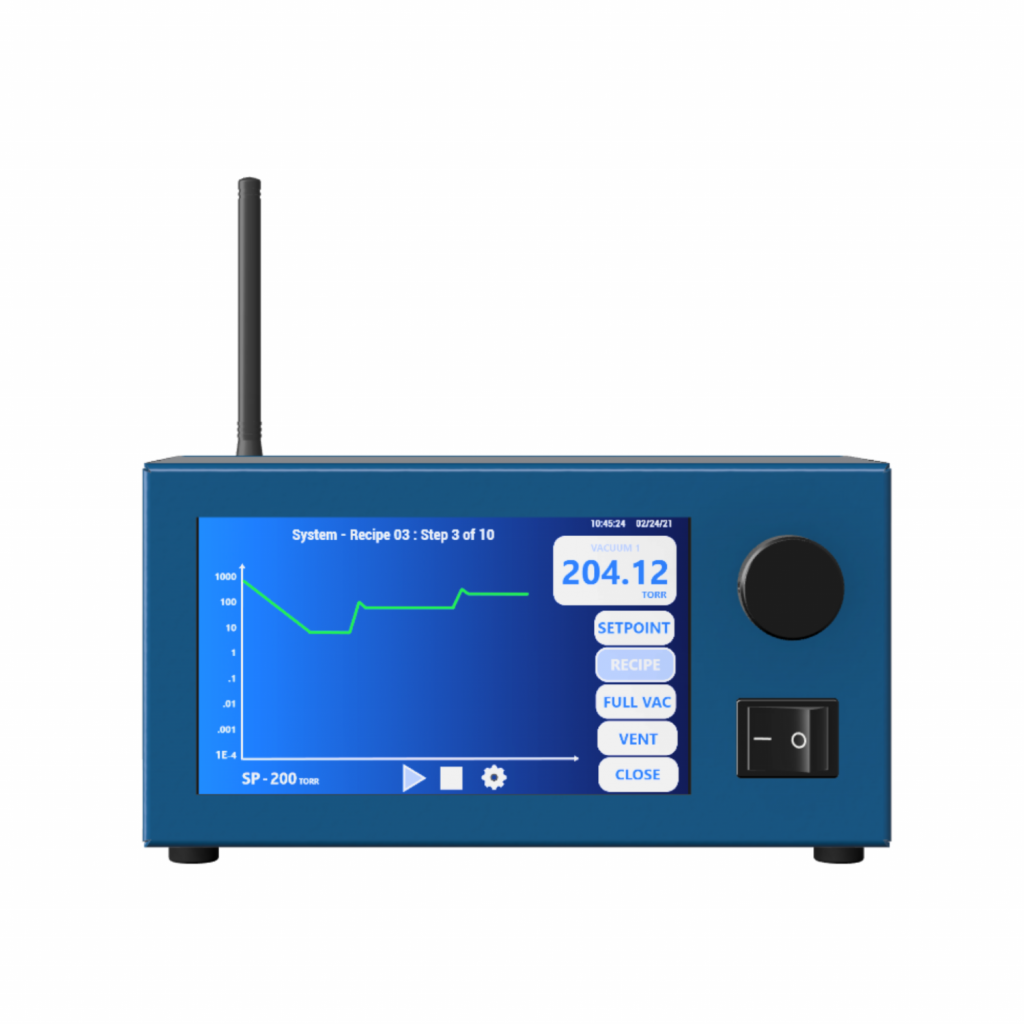
This is where the distinction is important. FYRA is the process monitor. SNAP is the process controller.
FYRA identifies when primary drying is complete while SNAP automatically performs the programmed control action, such as:
- Closing valves
- Switching pumps (based on need for high vacuum)
- Executing recipe-based process control
- Evacuation and purge cycles
Together they create a closed-loop automated vacuum drying system requiring little operator intervention.
Optional: Expand Automation with ATASPI and Temperature Control
For many vacuum drying applications, controlling vacuum alone is only part of the process. Temperature has an equally significant impact on drying rates, product quality, and total cycle time. By adding an ATASPI module to the SNAP Process Controller, manufacturers can automate both the vacuum and temperature portions of the drying process.
Integrated with a vacuum oven or heated chamber, SNAP can coordinate temperature control alongside vacuum control as part of a single automated recipe. Instead of manually adjusting oven temperatures or vacuum levels throughout the cycle, operators can program complete drying profiles that run automatically from start to finish.
With ATASPI-enabled temperature control, SNAP additionally can perform:
- Maintain programmed vacuum setpoints and recipes (up to 8 steps, 5 recipes).
- Ramp, hold, or change oven temperatures throughout the drying cycle.
- Coordinate temperature changes with vacuum process stages.
- Execute repeatable process recipes with minimal operator intervention.
Fully Automated Vacuum Drying System
This creates a fully automated vacuum drying system where both pressure and temperature are managed together, improving product consistency while reducing cycle-to-cycle variation.
Each component plays a distinct role within the overall system:
| Component | Function |
| FYRA | Monitors the drying process and determines the true End of Drying for every batch. |
| SNAP | Automates vacuum control, recipe execution, and process sequencing. |
| ATASPI | Expands SNAP to automate oven temperature control alongside vacuum control. |
| TORCH | Records vacuum and temperature data for process development, optimization, validation, and traceability. |
By combining FYRA, SNAP, and ATASPI, manufacturers can automate nearly every aspect of the vacuum drying process. The system not only determines when the product is truly dry but also controls the vacuum system and oven temperature throughout the entire recipe, resulting in a repeatable, efficient process that minimizes operator involvement while maximizing product quality.
For more information on our ATAPSI SNAP configuration you can read our blog about it here! It will explain its capabilities, features and connection to the temperature controller to enable both vac and temp control via the SNAP. Or Check out our product page here!
Benefits of Pairing FYRA with SNAP
- Higher throughput
- Less operator oversight
- Consistent drying
- Reduced cycle times
- Better repeatability
- Easier validation
| FYRA | SNAP |
| Monitors vacuum process | Controls vacuum process |
| Detects end of drying | Automates process actions |
| Analyzes vacuum behavior | Executes programmed sequences |
| Provides process intelligence | Performs process control |
Adding TORCH for Data Logging and Process Development
Enhance Process Development with TORCH Data Logging
While FYRA and SNAP automate production, TORCH adds another layer of insight by capturing detailed process data throughout every run.
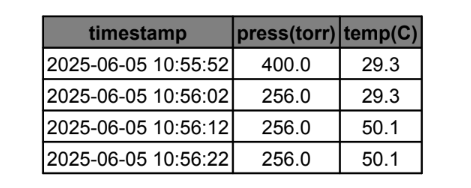
Depending on the application, TORCH can log:
- Dual vacuum measurements
- Vacuum and temperature simultaneously
- Time-stamped process data
- Complete process history
This information is especially valuable during research and development, where understanding the relationship between vacuum level, temperature, and drying time is essential.
By connecting TORCH alongside FYRA or SNAP, engineers can:
- Determine exactly how long primary drying is required.
- Identify the vacuum level throughout the entire cycle.
- Track temperature changes alongside pressure.
- Compare multiple process runs.
- Fine-tune recipes for faster drying.
- Optimize process repeatability before scaling to production.
- Create documented references for future validation and process improvements.
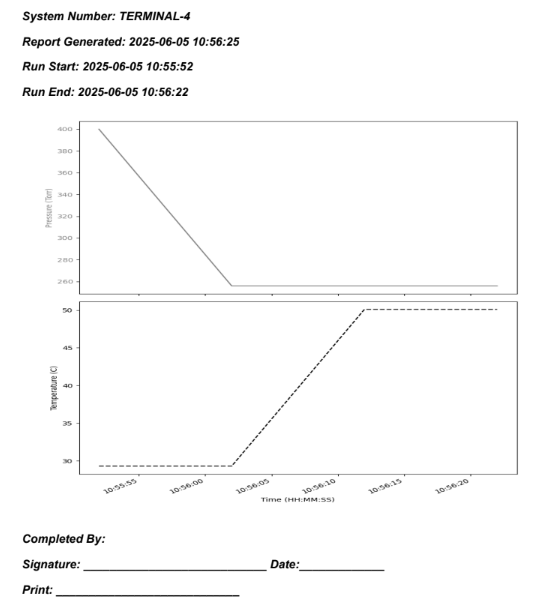
Rather than relying on manual notes or isolated measurements, TORCH provides a complete record of each drying cycle, making it easier to analyze trends and continuously improve the process.
Example of Torch Run Report
From R&D to Production
A major advantage of using all three products together is the ability to transition smoothly from development to production.
During R&D:
- TORCH records the complete process.
- Engineers determine the ideal vacuum profile.
- Drying times are optimized.
- Recipes are refined.
Once the process is validated:
- FYRA monitors the production process.
- SNAP automates the control actions.
- The optimized recipe can be repeated consistently from batch to batch.
This workflow shortens development time while improving confidence that production runs will match the successful R&D process.
Why End-of-Drying Monitoring Still Matters After Process Development
One of the most common misconceptions in vacuum drying is that once you’ve developed the perfect recipe, the process monitor is no longer needed. While a validated recipe provides an excellent starting point, real-world production batches rarely behave exactly the same.
Natural materials such as plant matter, botanicals, food products, and other moisture-sensitive materials can vary from batch to batch. Even when two loads have the same starting weight, differences in initial moisture content, density, harvesting conditions, storage environment, or product composition can significantly affect how long it takes to complete primary drying.
This is where the FYRA continues to provide value long after process development is complete.
Batch-to-Batch Consistency
Rather than simply running a fixed recipe for a predetermined amount of time, FYRA continuously monitors the drying process to determine how the current batch is actually behaving. If a batch contains less moisture than expected, FYRA can indicate that primary drying has been completed earlier than the nominal recipe time, allowing SNAP’s recipe to advance the process (skip to the next step) and reduce unnecessary cycle time. Conversely, if the material begins with a higher moisture content, FYRA detects that drying is still underway and allows the process to continue until the true end of drying has been reached ie. extend one of the SNAP’s recipe steps or repeat it to continue with drying.
Instead of assuming every batch is identical, the system adapts to the actual product in the chamber.
This approach helps manufacturers:
- Reduce unnecessary drying time on drier batches.
- Prevent under-drying when moisture content is higher than expected.
- Improve batch-to-batch consistency despite natural product variation.
- Increase throughput without sacrificing product quality.
- Minimize operator guesswork and manual intervention.
- Automatically compensate for normal variations in moisture content while maintaining the same validated process recipe.
By pairing FYRA’s real-time process monitoring with SNAP’s automated control, manufacturers gain a production system that doesn’t just repeat a recipe—it intelligently responds to the condition of each individual batch. The result is a more robust, efficient, and reliable vacuum drying process that maintains consistent quality even when the material itself changes from run to run.
FYRA Verifies the End of Drying For Every Batch
Determining the end of primary vacuum drying no longer has to rely on operator experience or conservative timing estimates. By combining FYRA’s intelligent process monitoring with SNAP’s automated control capabilities—and adding TORCH for comprehensive data logging during development—manufacturers can create a smarter, more repeatable vacuum drying workflow. The result is reduced cycle times, improved product consistency, and valuable process data that supports continuous optimization from R&D through full-scale production.
