
How a Custom Calibration Cart Streamlined Vacuum Gauge Validation
Custom Vacuum Calibration Cart for In-House Validation of Capacitance Manometers
Applications
Many vacuum processes rely on accurate sensor readings. However, calibration often requires sending gauges off-site, which causes delays and downtime.
DigiVac received an inquiry from a customer who operates in medium to high vacuum environments and needed to replace an discontinued calibration cart. Their application required calibration of 2 Torr, 100 Torr, and 1000 Torr capacitance manometers.
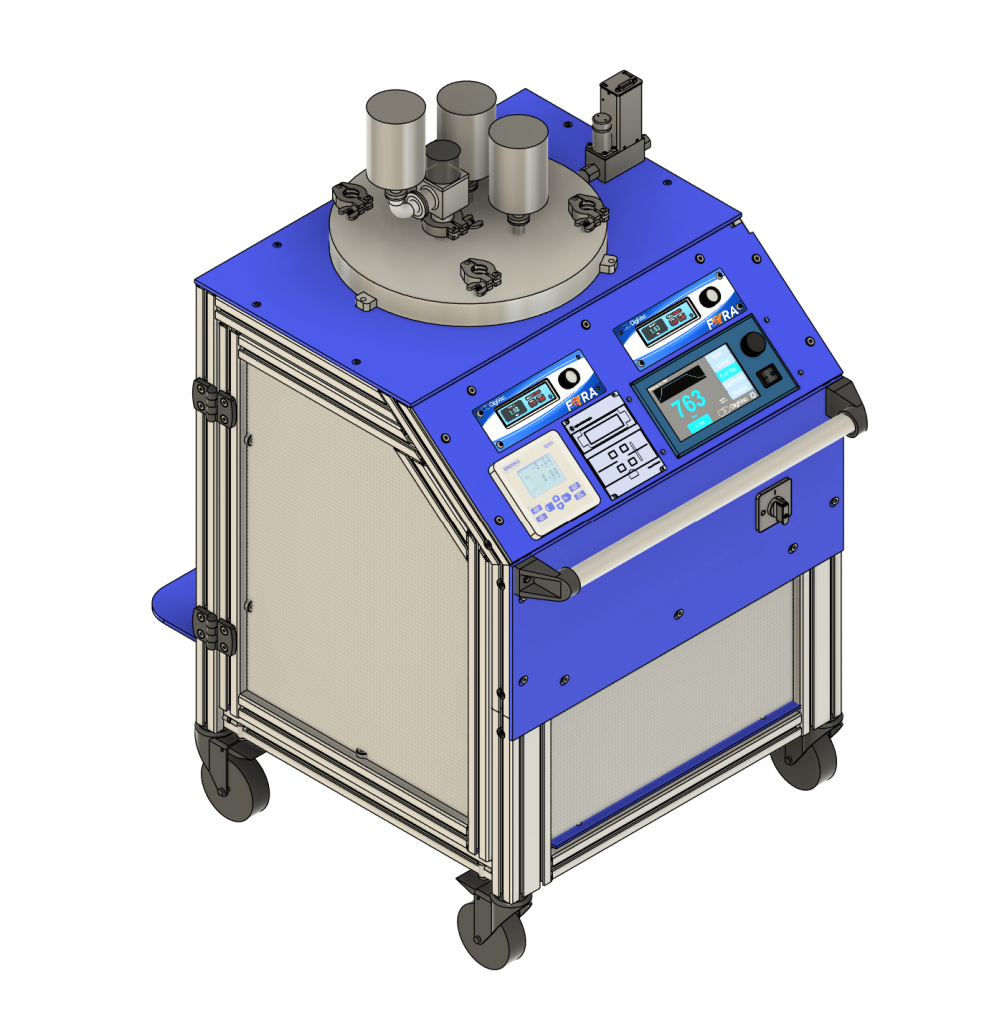
To solve this, DigiVac designed a custom vacuum calibration cart. This turnkey system allows for in-house calibration and validation, improving efficiency and reducing reliance on external services.
For example Ideal applications for the calibration system include:
- Aerospace vacuum systems (altitude chambers, leak testing, space simulation)
- Semiconductor and advanced manufacturing
- Research laboratories requiring high-precision vacuum validation
- Facilities replacing discontinued or legacy calibration carts
- Any operation seeking in-house vacuum gauge calibration capabilities
Use Cases
Similarly this vacuum calibration cart is ideal for:
- Manufacturing facilities avoiding downtime from off-site calibration
- Semiconductor fabs requiring precision vacuum measurement
- Research labs validating experimental conditions
- System retrofits requiring modern calibration infrastructure
- Process optimization (e.g., distillation, drying, vacuum ovens)
The Challenge: Costly Downtime & External Calibration Delays
Accurate vacuum measurement depends on properly calibrated sensors. However, outsourcing calibration (e.g., NIST services) can be:
- Time-consuming
- Expensive
- Operationally disruptive
Shipping gauges off-site often leaves critical systems without instrumentation, therefore creating unnecessary downtime and process interruptions.
The Solution: Turnkey In-House Vacuum Calibration System
By implementing an in-situ calibration and validation station, this customer gained full control over their calibration process furthermore benefiting not only from the system’s functionality but the efficiency in their lab space.
Key benefits:
- Perform vacuum gauge calibration in-house
- Eliminate reliance on external calibration services
- Reduce downtime and maintain continuous operations
- Improve measurement confidence and repeatability
System Configuration
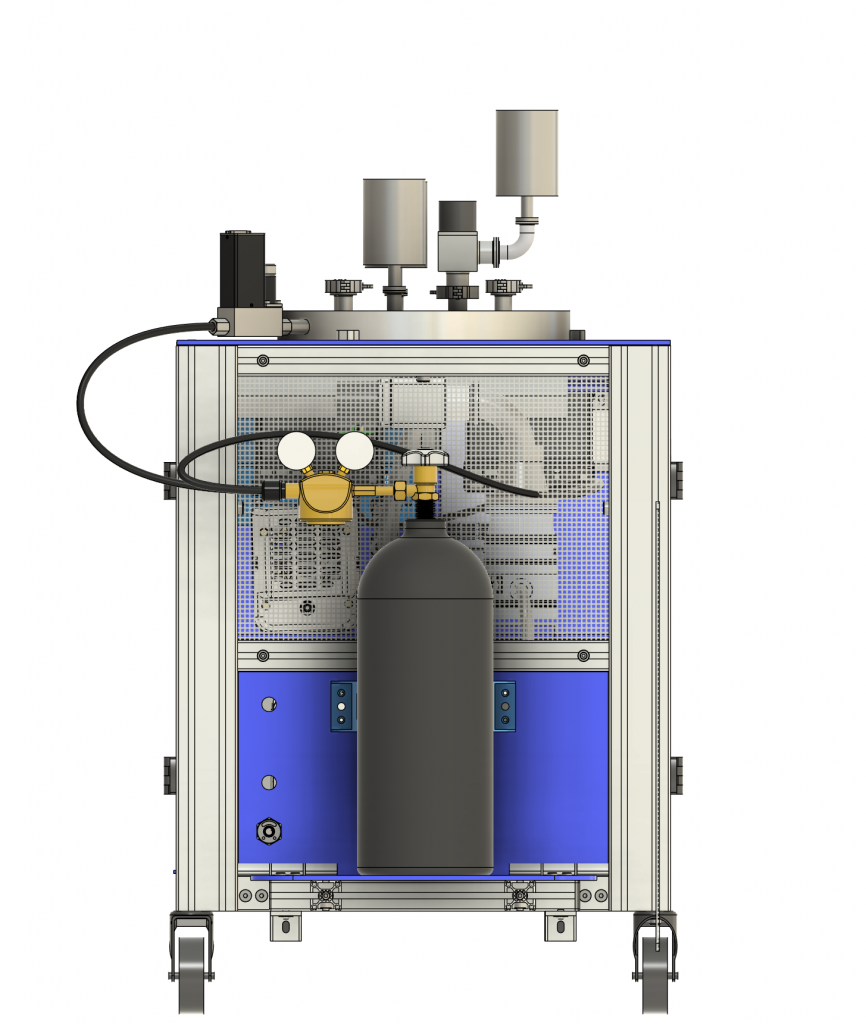
This custom vacuum calibration cart integrates precise components into a mobile, user-friendly platform:
- Electropolished vacuum manifold with (6) KF16 ports
- Cart-mounted turnkey system for mobility and ease of use
- Capacitance manometers (2 Torr, 100 Torr, 1000 Torr ranges)
- TwisTorr 74FS ISO63 turbomolecular pump
- IDP-3 backing pump with isolation valve
- IDP-7 roughing pump with isolation valve
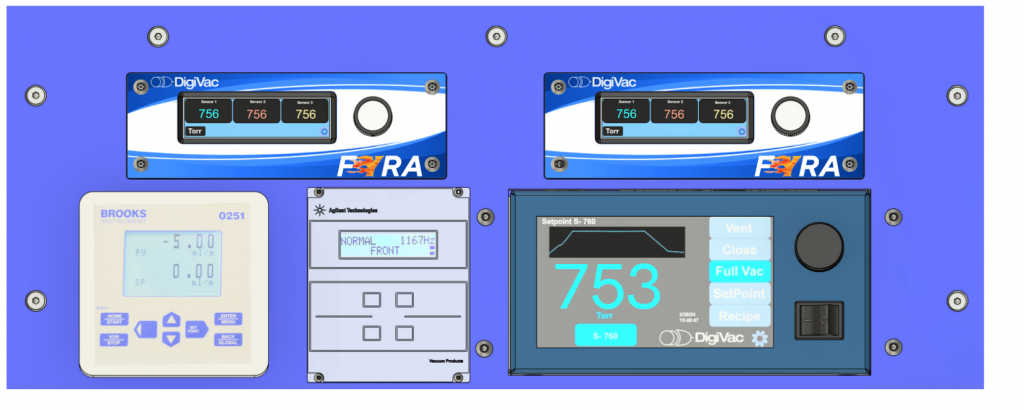
- Dual Fyra vacuum controllers
- SNAP vacuum controller with external DPCP sensor
- Mass Flow Controller for precise pressure control
- Nitrogen gas regulator
- UPS backup system (4-hour support for controllers and sensors)
- Full NRE support: design, assembly, testing, and on-site handoff
Configurations can be customized based on specific sensor types and calibration requirements.
How the Calibration Cart Works
This vacuum calibration system combines pumps, controllers, and sensors into a cohesive validation platform. This setup ensures high-precision, repeatable vacuum calibration across multiple pressure ranges.
All components work together to create a stable and controlled calibration environment.
For example, the pumps generate and maintain vacuum levels. Meanwhile, the controllers monitor and regulate pressure.
In addition, the system includes:
- Controlled nitrogen venting for stability
- Isolation valves to protect pumps
- UPS backup to maintain sensor readiness
Furthermore, the SNAP controller and mass flow controller improve pressure control across a wider range.
At the same time, dual Fyra controllers allow you to compare:
- Units under test
- Calibration standards
This setup ensures accurate and repeatable results.
Calibration Process Overview
Below is a description of the test used to validate readings from the units under test:
- Mount units under test and reference standards to the manifold
- Use the SNAP controller to set the desired calibration pressure
- Monitor real-time readings on both Fyra controllers
- Compare values between test units and standards
- Perform zeroing under high vacuum conditions
- Confirm consistency and validate sensor accuracy
This process provides fast, reliable validation of vacuum gauges without removing them from your workflow.
Key Features & Advantages
- In-house calibration capability reduces operational delays
- Simultaneous measurement improves efficiency and accuracy
- Automated pressure control simplifies testing
- Expanded measurement range with external sensor integration
- System protection via isolation valves and controlled venting
- Power safety with UPS-backed sensor stability
Conclusion
Ultimately this custom turnkey vacuum calibration system delivers a reliable, adaptable solution for in-house validation of capacitance manometers. By combining vacuum hardware with intelligent control, the system ensures:
- Accurate and repeatable calibration
- Reduced downtime
- Simplified workflows
- Long-term confidence in vacuum measurements
For organizations operating in demanding vacuum environments, an in-house calibration cart is a strategic investment in efficiency, accuracy, and process reliability.
Discover how a Vacuum Calibration Cart can improve accuracy and reduce downtime—explore the full solution here.
